Ads used to be here |
 |
 |
 |
 |
 |
 |
 |
 |
|
|
||||||
|
||||||
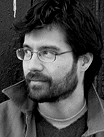
Inspired by the short stories of science fiction writer Ray Bradbury, Greg is a brilliant storyteller whose enthusiasm for the medium of film and love of science fiction is evident in his body of work, which span several genres.�Engaging, intelligent and perceptive, his path to movie making has been an unusual one.� After graduating from Yale with a degree in political science, the writer/director was on his way to becoming a politician when a stint in film directing while studying history at Oxford on a Rhodes scholarship focused his vision on his true passion-filmmaking. Back in the States, he enrolled in the graduate film program at New York University and combining his diverse interests in photography, writing, drawing, and acting -- all talents he�d pursued since childhood -- he set about honing his skills in the craft of filmmaking. During his first year at NYU, his first short film Visiting Aunt Sue was accepted at the Asian American International Film Festival in New York. He�s never looked back. In 1998, I saw Mouse, Greg�s hilarious 11-minute short film about a guy trying to escape a conversation about pregnancy with his girlfriend by chasing a mouse around his apartment at the Asian American International Film Festival in New York. As I laughed out loud, I remembered thinking�this filmmaker is one to watch! In addition to making his own movies, Greg edits two film related websites FilmHelp.com and AsianAmericanFilm.com. He was the cinematographer of "The Personals," an Academy Award winning short documentary, and was featured on the cover of Time Magazine Asia for his work in digital filmmaking. I caught up with Greg in New York to talk about his passion for filmmaking, his love of movies, and what it was like to be in production with his first feature Robot Stories, a �science fiction from the heart� series of four short films about love, death, family and robots in the midst of the September 11th attacks on the World Trade Center.�Robot Stories, winner of the Best Screenplay Award at the 2002 Hamptons International Film Festival has the coveted closing night spot at the San Francisco International Asian American Film Festival and plays on March 13th at 7p.m. at the AMC Kabuki 8 Theaters. Lia:� Why is the SFIAAFF important to you? Greg: All of the Asian American film festivals are important to me because they�ve all been amazing to me as a filmmaker. I�ve had short films kicking around these festivals for ten years. These Asian American film festivals have always been homes to my films.�The folks who run them have always been supportive.� It�s been a great experience to screen my films at these festivals.� To be opening or closing night has always been one of my dreams. The SFIAAFF is particularly exciting to me because they�ve stepped up and Robot Stories is the closing night film.� That is huge to me. They are giving it a really good spotlight. The SFIAAFF is a great festival-it is really well run.� They tend to sell out a lot.� The audiences are great.� It�s just an exciting place to be.� San Francisco is a great movie going town.�The audiences love independent movies. There are so many festivals in San Francisco and they seem to do really well. Some of my short films have played five or six times at different festivals in SF.� I�ve had a bit of luck. It feels like a friendly town.�I�ve got my fingers crossed.Lia:� Where did you go to film school? Greg:� I went to NYU grad film and several of the short films that I made there did pretty well. Fighting Grandpa got a Student Academy Award, played on Cinemax and PBS and a ton of festivals.�And I made a short film called Mouse, which played a ton of festivals and won a lot of awards. I�ve done about ten short films over the years. More recently I made All Amateur Ecstasy and Asian Pride Porn, short porn spoofs that have done incredibly well at AtomFilms.com. Asian Pride Porn stars Tony Award winning playwright David Henry Hwang as a celebrity pitchman for progressive pornography featuring smart Asian women and sexually empowered Asian men.�I�m always kind of surprised at how many people I bump into who tell me they�ve seen that one.� My mantra coming out of NYU was that I just wanted to keep working �just keep working no matter what. Like most struggling filmmakers, I didn�t have a lot of scratch.� So I made digital short films. The films I made while I was at NYU were on 16mm.� But 16mm is expensive.� So I started doing digital shorts as the technology became available.� It was just a way for me to keep working, to keep my name out there, to keep going to festivals and to keep learning by continuing to be a filmmaker.�All the time I was trying to raise money to do a feature. I�d written a number of features. And had gotten agents and felt like things were going to happen.�But it was really tough.�The features that I�d written required more money than most companies want to give to first time filmmakers. After several years of this kind of struggling for attention, I wrote something that I could produce for a lot less money.�The kind of money that I could scrounge up from family and friends.�That was Robot Stories.� We went into preproduction in July 2001.�We went into production on Sept 10th, 2001. We were shooting in Brooklyn on the 11th.�Finished shooting in October, did a sneak peek at the Visual Communications Film Fest in Los Angeles in May 2002, and had our world premiere in October at the Hamptons International Film Festival where, Robot Stories won Best Screenplay Award.� Since then we�ve been at a number of festivals -- in January, we played Slamdance, which is sort of the little brother festival to Sundance.�It happens at the same time in Park City.�� Now we�re on the verge of going to a ton of pretty amazing festivals in March and April.� We�re kind of bugging out, frankly. Cinequest in San Jose, South by Southwest in Austin, TX, Florida, the Santa Barbara Film Festival and then we�re the closing night at the SFIAAFF. Which I�m hugely excited about because it�s really amazing to be the closing night film at a festival which has shown so many of my short films over the years, supporting me so much. It�s like coming home. Then we�re the opening night film on April 4th at the Chicago Asian American Showcase.� That�s also stupendous. We�re an independent film, so right now we�re trying to build an audience so that there are a lot of people that are passionate about the film and will come see it when it goes to theaters.� And to get a distributor - that�s the dream.� You try to get an established distributor to pick you up and take you out into the world theatrically. Lia:� Let�s talk about your first feature Robot Stories�. Greg: Almost all of the leads are Asian American. The movie is actually pretty multiethnic.� There are folks of every ethnicity in it in important roles. But the leads are all Asian or half-Asian. Four stories-love death family and robots are the themes.� It stars Tamlyn Tomita, Sab Shimono, Wai Ching Ho, myself, and a bunch of other great actors Cindy Cheung, Tim Kang, James Saito, Ron Domingo, Julienne Hanzelka Kim, Bill Coelius, Eisa Davis. The movie is science fiction. It�s four stories� - they are all kind of Twilight Zoney in a way.� Each of the stories is about 20-25 minutes long and each one of them has some kind of twist.� Each one of them has some kind of crazy robot thing going on. But a special kind of science fiction � we�re calling it �science fiction from the heart� or �domestic science fiction.� Essentially the stories are all about couples or families struggling with life crises.�� Struggling with human stories that couples and families struggle with.� One of the inspirations was Ray Bradbury�s short stories.� I grew up reading Ray Bradbury.� Ray Bradbury was born on Aug 22; I was born on Aug 23.� I remember being incredibly happy when I found that out. That kind of vision of using fantastic themes and fantastic elements to tell a deeply human story has really stuck with me.� I think that�s a good guideline for any kind genre movie making or storytelling in general.�� An action movie, a costume drama, a pirate picture, whatever � it�s only going to move you if you care about those characters.�
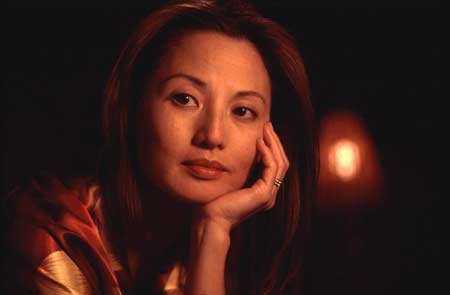
My Robot Baby: stars Tamlyn Tomita and James Saito as a couple that want to adopt a baby.� But before they can adopt a human baby they have to take care of this little robot baby.� And of course something goes terribly wrong.
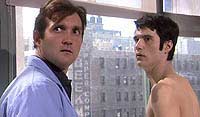
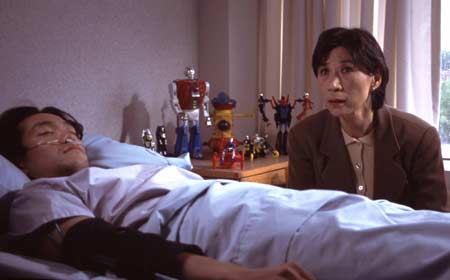
Robot Fixer: stars Wai Ching Ho and Cindy Cheung.� They play a mother and a daughter.� The son has been hit by a car and is in a coma. The story is about this mother�s struggle to come to terms with the fact that she never knew her son.� He�s one of these eccentric, introverted geniuses who nobody ever really knows. She�s in denial about all of that and becomes obsessed with finishing the toy robot collection that he kept from his childhood.� As if by finishing this toy robot collection she�s somehow going to be able to reach him. Machine Love: That�s the one that I�m in.� It�s about a robot office worker who�s programmed to interact with people in the office he�s assigned to so that he can learn and adapt and be the perfect co-worker.� The problem is that he gets assigned to this really dysfunctional office where nobody wants to interact with him. Everybody treats him badly.� What he ends up learning is that he too needs love.� Bill Coelius plays the woebegone tech support guy who�s in charge of dealing with the robot and Julienne Hanzelka Kim plays the female robot in the office across the street.
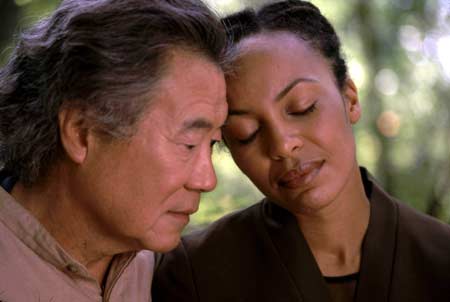
Clay: Stars Sab Shimono as an old sculptor who�s dying.�But this is in a world in which nobody dies.�Instead, when you reach the point of death, your memories are scanned into a computer and essentially you live forever. It�s a story of this old man who has to decide between natural death or digital immortality.�Ron Domingo plays the son. Eisa Davis plays the wife who was scanned years before and sort of lives in this strange digital world where once you�ve become scanned, you attain this perfect peace and this zen-like calm -- which is unsettling for the old man.
Lia:� What kind of response did you have at Slamdance? Greg: Great! Packed houses, great reactions.�Before we started going to festivals, I felt like we had two core audiences.�One was fans of smart science fiction.�The geek vote.� Folks who grew up reading Ray Bradbury, who love thinking about these kinds of things and are just waiting for the next smart science fiction movie.� Certainly, we had a core audience with Asian Americans.�The same kind of folks who go to the film festival and have been supporters of my films for years. Second and third generation Asian Americans.�� Now we�re seeing that the film is really tapping into a third important audience -- older, mainstream moviegoers who are looking for emotionally compelling work. We�ve gone to places like the Hamptons, an older, less ethnically diverse place, and the film went over incredibly well. That traditional art house film audience has really gone for the movie. Because while it has this crazy genre thing going on and a quirky sense of humor, it�s also grappling with real life issues about families.�Two of the main characters in the picture are in their 50�s or 60�s.�That�s exciting. I am hoping that the film will bring these varied audiences together.� Lia:� What informs you when you are developing subject matter for your film?� Greg: �At the time I did Mouse, I realized that there were not many movies being made by Asian Americans which didn�t have anything to do with so-called Asian American issues, but which starred Asian Americans.�I think that�s really important.� It�s also important to make films explicitly about race.�But when I roll out of bed everyday, race is not the first thing in my head.�The first things in my head have to do with love, sex, and family - very basic human emotions. Race becomes this kind of substrata on which all these other things play out.� One of the things that I�ve been doing is just telling stories that deal with emotional problems that interest me and casting just the way I see them.�And not making apologies for it.�That�s what we did with Robot Stories. The fact that we are playing so many big mainstream festivals means that these kinds of images are getting out to people that would never see them otherwise. It normalizes it. In this day and age it is important to normalize - there are still folks who question the Americaness of Asian Americans. Purely because of race.�In some small way, just by depicting people as just normal people with normal problems�I think in some small way, movies can make a difference. Lia:� Did you shoot Robot Stories in digital? Greg: We priced out a number of options and shooting digitally was the only way that it would make sense. I�d seen a lot of stuff that looked terrible-feature films.�I knew that we could do better-my cinematographer�s great.�His name is Peter Olsen. We went to NYU together. We spent a lot of time doing tests, coming up with strategies and working on ways to insure that the film could look as good as it looks.�We shot digitally.�We shot DV cam and we shot Pal, the European standard, which gives you more lines of resolution and ultimately a better image.�When you blow it up to film for theatrical release, you have more information to put on that film frame. The film looks better than I ever expected it to when it is projected on film.� If you are in the business and you are used to seeing video transfers, you�ll be able to figure out that this was shot on digital. For civilians, you want people not to be distracted. You want people to lose themselves in the fantasy of the movie. And not be wondering about my technical issues. Lia:� You started shooting Robot Stories on Sept 10th of 2001.� You were actually shooting on 9/11 in New York. What was that like? Greg: On the 10th, our first day of shooting, it rained. �We were shooting in Central Park.� It was a beautiful day.�Clouds rolled in and it rained on us in the afternoon.�There was this big scramble.� With the first day of shooting, we were dealing with -- Are we going to keep shooting? Are we going to stop?�We decided we were going to do it. We shot the scene.� The shot that we shot in the rain was the climactic scene of the Robot Fixer, which was a very emotionally charged scene.�It turned out to be perfect that we shot it in the rain. Of course it was raining.�It had to rain for that scene. We felt like we had this huge challenge on the first day.�Now we can do anything.� Of course the next day was 9/11.�That morning-we had a driving rig.�For the first time I was going to direct a scene in a car which was going to be pulled on a rig.�That was the technical challenge of the day. We were rehearsing the scene.�We heard that a plane hit the World Trade Center. I thought it was a Cessna or something like that. I had no idea it was a jetliner.�Or that it was terrorists.�It just seemed like this terrible accident. We ended up shooting the scene we were working on and then the towers started falling and ash started blowing.�We ended up walking into the holding area and watching television shell-shocked. It�s one of those crazy things because when you are working in independent films, there is this �by any means necessary� mentality.�It�s so hard to do it.�You are doing it on limited resources.�A soldier mentality -- do it no matter what.�� There are stories from 9/11, filmmaker Sydney Lumet was shooting all day.�It was crazy but at the same time you gotta respect that.�Once that ash started blowing over we shut down for the day.�Who knows what was in that ash? We just had no idea. We were just freaking out -- just watching those televisions like everybody else.�What the heck was going on? At the same my producers Karen Chien and Kim Ima and my assistant director Curtis Smith were thinking ahead.�We�ve got this rig on the street -- how are we going to deal with that?�How are we going to get everybody home because the bridges and tunnels were closed? What were we going to do tomorrow and the day after that?�How are we going to deal with this? It was unprecedented.�You always expect something to go wrong on a film shoot. But this was beyond the pale.� We ended up coming back the next day. It�s become a clich� but it�s become what people were talking about.�That whole thing of �if we don�t, they win.��Cindy Cheung and Wai Ching Ho were my actors in this scene for The Robot Fixer. I was so happy they were the actors I had. It was huge to me.�It was important for me to keep shooting; it was emotionally valuable and vital for me to keep shooting and just working with them.�Being able to go every day.�We were working on a story where a mother was dealing with the death of her son.�It�s totally high stakes. Deeply emotional material.�It gave me a way to get through every day.�It was also a way for us to deal with all of these emotions that we were grappling with. My cast and crew were just amazing.�They really wanted to keep working.� It was a great thing to be able to work with them at that time. Lia:� Do you think 9/11 affected your storytelling in any way? Greg: I never changed any dialogue.�I didn�t react consciously.�I didn�t address it in any way in the filmmaking.�The strangeness and the rawness of the time.�That uncertainty informed the production and informed the performances.�We were all so raw.�It reinforces our reasons for doing the movie. It clarified why telling these kinds of stories are important.� These are stories about people who are struggling to find each other.�And struggling for meaning and struggling for connection in some way.�These are flawed people who are trying to connect with each other.�That act of human connection.� When something like 9/11 happens -- what�s really important in this world? My father was having some health problems during that time.�I remember talking to him.�It was really terrible.�He came to terms with what�s really important are his wife and his family.�Just like the people who you love.�Finding some way to reach them or to be true to them. Lia:� What do your parents do? Greg: My dad is a research physician who has done a lot of work in the study of calcium and bone disease and developing drugs for that. My mom taught English early on but became a homemaker when she had kids. I have an older sister and a younger sister.�My older sister is a surgeon in San Francisco.�My younger sister is in a PhD program in linguistics in Philadelphia.� Lia:� Were your parents supportive of your decision to pursue filmmaking? Greg: Yes. They are great parents and they only want what will make me happy. They believe in the work.�It�s helped that the work has done well and that they like it.� Robot Stories meant a lot to my father too. He really cared about the stories.�I would send him cuts while I was working on it. It was important for me to make the movie.�The movie became important to him too. Lia:� What�s next on the docket? Greg: Karen Chien who co-produced Robot Stories is co-producing my next feature -- Rio Chino.�It�s a western with a Chinese gunslinger as the main character set in the old West.� We�re trying to raise money so that we can make that our next project. That�s actually one of the dream projects that I have been working on for years but couldn�t raise the money for before Robot Stories.�Every time something good happens with Robot Stories it helps us with getting meetings to talk with people and getting this next project off the ground. We�ve got our fingers crossed.�Last October I got the Independent Film Project�s Pipedream screenwriting award for Rio Chino.� Lia:� Besides Rio Chino where do you see yourself in 5 years? Greg: Five years from now I�m hoping that I will have made at least one or two more features. I�ll have a little more financial security.�I just want to keep doing what I am doing.�That is my goal. That I can continue to write and make movies. And that I can get paid enough to keep doing it. |
||||||
|
|



 AsianConnections
Arts & Entertainment Editor Lia Chang (left) currently appears as
Nurse Lia on As The World Turns and One Life to Live.
Based in New York, she works as an actor, a photographer, a multimedia-journalist
and designs greeting cards. AsianConnections wishes to thank Lia
and Greg for their generous time and efforts in making this interview
possible. For more on Lia, visit her website at
AsianConnections
Arts & Entertainment Editor Lia Chang (left) currently appears as
Nurse Lia on As The World Turns and One Life to Live.
Based in New York, she works as an actor, a photographer, a multimedia-journalist
and designs greeting cards. AsianConnections wishes to thank Lia
and Greg for their generous time and efforts in making this interview
possible. For more on Lia, visit her website at  |
|||
|
 |
|
|
| | About Us | Disclaimers and Legal Information | Advertise With Us | We welcome your comments. Send e-mail to us at info@asianconnections.com Copyright ©1999-2002 AsianConnections.com |